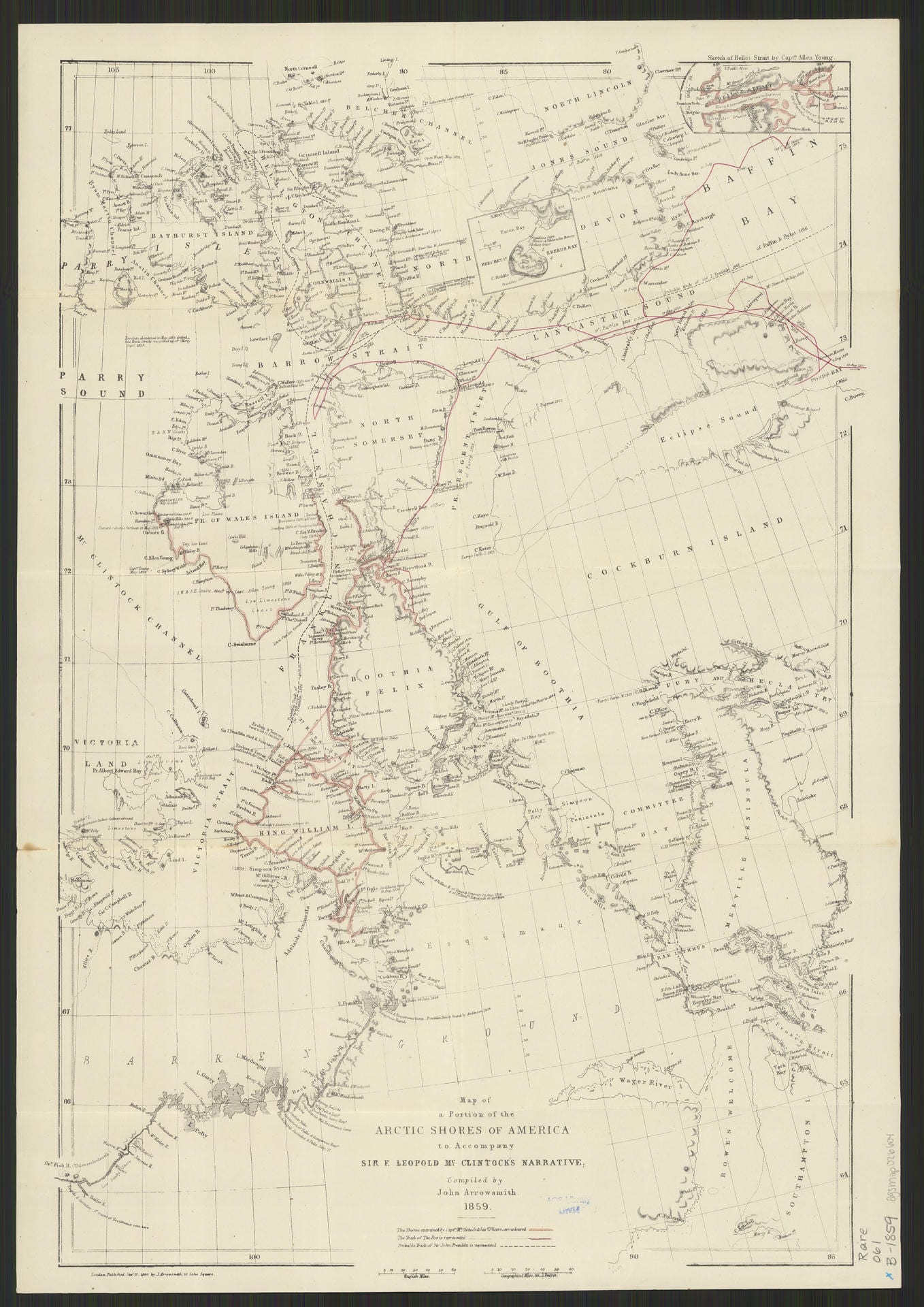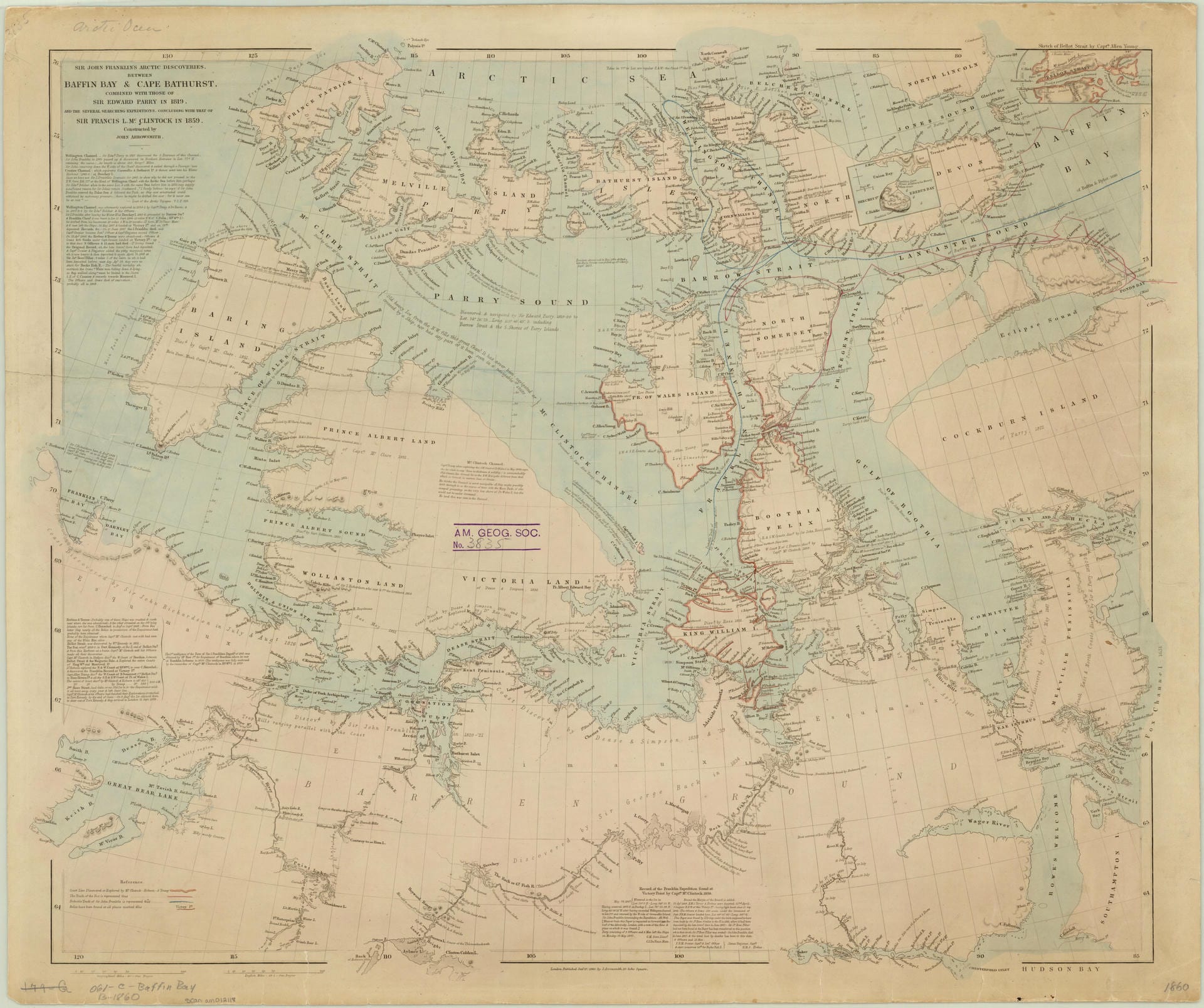
Map of a portion of the Arctic shores of America to accompany Captn. Mc Clintock's narrative / compiled by John Arrowsmith”; “Sir John Franklin's Arctic discoveries, between Baffin Bay & Cape Bathurst, combined with those of Sir Edward Parry in 1819, and the several searching expeditions, concluding with that of Sir Francis L. McClintock in 1859
Among the most famous and consequential series of European Arctic explorations occurred in the 1840s and 1850s. Sir John Franklin, a seasoned explorer and officer in the British Royal Navy who had previously led two Arctic expeditions, was chosen in 1845 to command two ships, the HMS Erebus and HMS Terror, on an expedition to map the final stretch of unexplored coastline in the Canadian Arctic archipelago that would complete the fabled Northwest Passage. Despite reaching North America in the summer of 1845, the expedition disappeared, prompting the British government in 1847 to offer a reward of £20,000 for information about the fate of Franklin and his crew.
Because of Franklin’s status and the high value of the reward, dozens of American and European expeditions were sent in search of the Erebus and Terror, which inadvertently resulted in significantly more deaths than the original crew of roughly 150 men, but also a number of important Arctic discoveries. For example, some consider that John Rae became the first European to discover a completed route of the Northwest Passage in 1854, an expedition during which he also became the first to claim knowledge of Franklin’s fate, having heard from local Inuit guides that the Erebus and Terror were smashed by ice and the crew had resorted to cannibalism. Rae’s accounts scandalized Victorian British society and ultimately disrupted his career, likely preventing him from receiving a knighthood.
The maps featured below show the exploration of Sir Francis Leopold McClintock, who set off in 1857 at the behest of Lady Jane Franklin to confirm her husband’s fate. In early 1859, McClintock and his crew, like Rae five years before, were told by local Inuit that Franklin’s ships had been wrecked off King William Island. McClintock’s crew were able to find a written record that had been left by Franklin’s men, confirming the shipwreck in September 1846 and Franklin’s death in June 1847. McClintock returned to Britain in September 1859 with this information, where he was knighted and given a cash reward. The tale was recorded in The Voyage of the “Fox” in the Arctic Seas: A Narrative of the Discovery of the Fate of Sir John Franklin and His Companions, for which this map served as a companion. Among other things, McClintock’s account dispels ideas that Franklin and his crew resorted to cannibalism, and further incorrectly credits Franklin with discovery of the Northwest Passage. John Rae’s reputation would be rehabilitated in the late twentieth and early twenty-first century as greater research confirmed that his accounts of cannibalism were indeed correct, while a motion was advanced in Parliament to describe Rae, not Franklin, as the true discoverer of the Northwest Passage.